

µCom-USBC
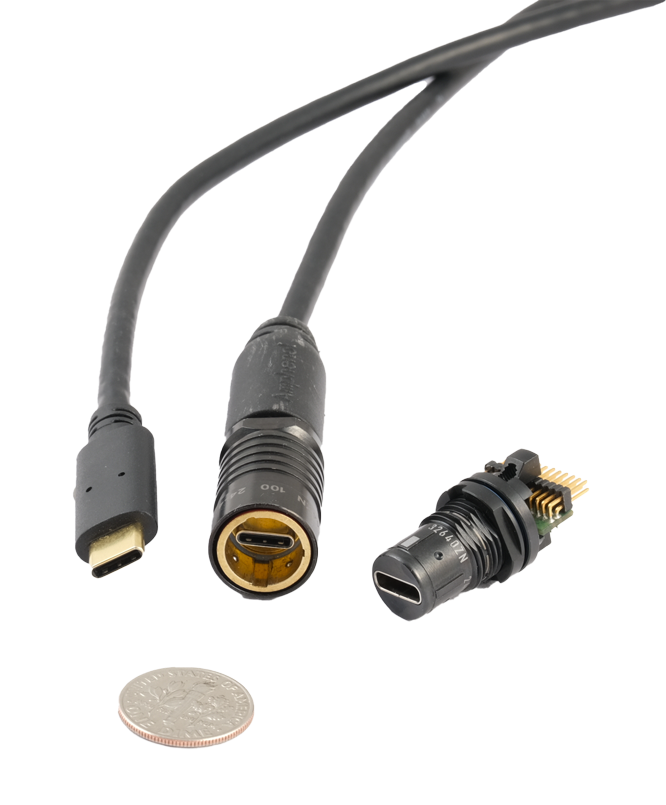
µCom-USBC
Key features
- Receptacle and Plug diameter 15mm [0,59inch]
- Fully reversible connector, various data transmission capabilities and power delivery
- Sealed against fluids and dusts (IP68)
- Brass material plated Black zinc nickel RoHS
- 500h salt spray resistant
Applications
- Soldier Worn Equipments
- C6ISR Battlefield Communication
- Grounded vehicles
- Military avionics
- Data transmission up to USB3.2 Gen2 specifications
- Video transmission DP1.4 Alt Mode
- Fully reversible
- Power Delivery: Up to 100 Watts (20V/5A)
- Maximum length transmission:
- Up to 1 m - USB3.2 Gen2
- 1m to 2 m - USB3.2 Gen1
Mechanical features
- Shell diameter: 15mm [0,59inch]
- Shock, vibration, and traction resistance
- EMI protection: Shielding continuity
- Low Smoke Zero Halogen cable jacket and overmolding
- Vibrations according to MIL-STD-810, Method 514.8 Category14:
• Push Pull version : 500Hz 1h/axis ; no discontinuity >10µs
• Threaded version : 500Hz 4h/axis ; no discontinuity >1µs - 1 single receptacle to mate threaded plug or push pull plug
- Mating plug/receptacle cycles :
• Push Pull version : 2000 cycles
• Threaded version : 500 cycles - Sealing: IP68 mated and unmated
- Salt spray resistance: 500 h with brass shell & Black zinc nickel plating - ROHS compliant
- Shock resistance: IK06 onto mated pair
- Operating temperature: -40°C to +85°C (-40°F to 185°F)
Other products you may be interested in


1. What is the µCOM-USBC connector?
The µCOM-USBC is a miniaturized, ruggedized USB Type-C connector system designed for harsh environments. It leverages the µCOM form factor and is available with either push-pull or threaded coupling mechanisms to ensure reliable connectivity under shock, vibration, and environmental stress
2. Which USB standards are supported?
The connector supports USB 3.2:
- Up to USB 3.2 Gen2 for cable lengths up to 1 m
- USB 3.2 Gen1 for cable lengths from 1 m to 2 m
This enables high-speed data transmission while maintaining ruggedized performance
3. Is the connector fully reversible?
Yes. Both the plug and receptacle are fully reversible for data and power, in compliance with the USB Type-C standard. This eliminates orientation constraints during mating
4. What are the power and voltage ratings?
The µCOM-USBC connector supports:
- Maximum current: 5 A
- Maximum voltage: 20 V
- Dielectric withstand voltage: 100 VAC
These ratings allow compatibility with USB Power Delivery use cases within rugged systems
5. Does the connector support video transmission?
Yes. The connector supports DisplayPort 1.4 Alt Mode, enabling video transmission over USB Type-C for applications such as displays, consoles, and vision systems
6. What coupling mechanisms are available?
Two coupling systems are offered:
- Push-Pull coupling for fast and intuitive mating
- Threaded coupling for maximum resistance to vibration and accidental unmating
The receptacle is compatible with both plug types, simplifying system design
7. How does the connector perform under vibration and shock?
The connector is qualified according to MIL-STD-810, Method 514.8, Category 14:
- Push-pull version: 500 Hz, 1 h per axis, no discontinuity > 10 µs
- Threaded version: 500 Hz, 4 h per axis, no discontinuity > 1 µs
Additionally, it provides IK06 shock resistance when mated
8. What is the environmental sealing level?
The µCOM-USBC offers IP68 sealing in both mated and unmated conditions (1 m immersion for 1 hour). This makes it suitable for exposure to dust, fluids, and harsh outdoor environments
9. What EMI protection is provided?
The connector ensures shielding continuity across the mated interface, providing effective EMI protection suitable for sensitive communication and C4ISR systems
10. What materials and platings are used?
The connector features machined brass shells with black zinc-nickel plating. This combination provides mechanical robustness, corrosion resistance, and long-term reliability, including 500 hours of salt spray resistance
11. What is the mating cycle durability?
- Push-pull version: 2,000 mating cycles
- Threaded version: 500 mating cycles
These figures support repeated use in operational and maintenance scenarios
12. What is the operating temperature range?
The connector operates from -40 °C to +85 °C (-40 °F to +185 °F), covering most military, naval, and industrial environmental requirements
13. Which applications and markets are targeted?
The µCOM-USBC is intended for demanding applications such as:
- Ground vehicles
- Soldier-worn systems
- Naval and battlefield C6ISR
- Displays, consoles, vision systems, and situation awareness equipment
14. Is the product compliant with environmental regulations?
Yes. The µCOM-USBC connector is RoHS compliant, supporting integration into regulated markets and environmentally responsible designs
15. Is the µCOM-USBC suitable for military and defense programs?
Yes. The µCOM-USBC is explicitly designed for defense and tactical environments, including ground vehicles, soldier-worn equipment, naval platforms, and C6ISR systems. Its ruggedized construction, environmental sealing, EMI shielding, and vibration resistance make it suitable for deployment in mission-critical defense applications
16. Which military standards does the connector comply with?
The connector is qualified for vibration per MIL-STD-810, Method 514.8, Category 14, with stringent discontinuity thresholds depending on the coupling type. This standard is commonly referenced in military and defense qualification plans for ground and mobile platforms
17. Is the connector resistant to harsh battlefield environments?
Yes. The µCOM-USBC provides:
- IP68 sealing in both mated and unmated states
- Resistance to dust, fluids, and immersion
- IK06 shock resistance on mated pairs
These characteristics support reliable operation in battlefield, naval, and outdoor tactical environments
18. How does the product address EMI/EMC concerns in defense systems?
The connector ensures shielding continuity across the mated interface, providing effective EMI protection. This is critical for defense systems where signal integrity, electromagnetic compatibility, and co-location of sensitive electronics are key procurement requirements
19. Is the product qualified or still under qualification?
Yes, the product is qualified.
20. Are different coupling mechanisms available to meet mission requirements?
Yes. Defense programs can select between:
- Push-pull coupling for rapid connection and disconnection in the field
- Threaded coupling for maximum resistance to vibration and accidental unmating
This flexibility allows adaptation to different mission profiles and maintenance concepts while keeping a common receptacle interface
21. Does the connector support long-term durability in deployed systems?
Yes. The connector is designed for extended service life with:
- High mating cycle durability
- Corrosion-resistant plating with salt spray resistance
- Robust machined brass shells
These features support sustainment and lifecycle requirements common in defense procurement programs